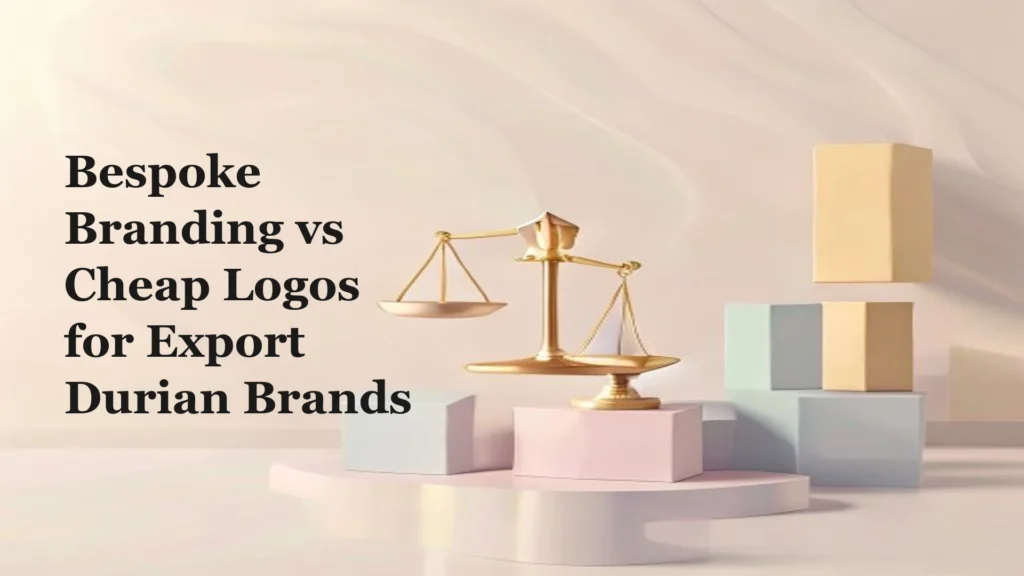
Export durian brands face a critical choice between investing in premium custom branding and settling for low-cost logos, a decision that directly impacts market perception, price premiums, and long-term buyer trust.
Bespoke Branding Builds Premium Market Authority
A custom visual identity for export durian brands creates instant differentiation in crowded Asian markets. Bespoke branding involves deep research into target cultures—like luxury gift-giving norms in China or status signaling in Singapore—resulting in packaging, color schemes, and typography that communicate rarity and quality. This approach attracts high-margin buyers such as upscale supermarkets and gifting platforms, where a single box of Musang King can sell for $120 versus $60 for generic lookalikes. The upfront investment typically ranges from $8,000 to $25,000, but the return materializes as a 10–15% price premium on wholesale orders.
Cheap Logos Erode Perceived Durian Quality
A hastily designed logo downloaded from a template site undermines the premium image required for export-grade durian. Cheap logos often suffer from poor scalability on packaging, clashing with the product’s natural heritage story—for example, using a cartoonish durian face on a box meant for high-end Hong Kong retailers. Buyers in markets like Japan and South Korea associate amateur visuals with inconsistent fruit quality, fungal issues, or short shelf life. Surveys show that 68% of importers rank packaging design among their top three purchasing criteria, and a generic logo reduces willingness to pay by 18% compared to a bespoke alternative.
Cultural Nuances Demand Custom Visual Strategy
Export durian brands must decode color symbolism and typography preferences across different geographies. In Thailand, deep purple and gold signal royalty and premium; in China, red and gold dominate, but black can denote death or sophistication depending on context. Bespoke branding agencies conduct field tests and local focus groups to avoid taboo symbols—like rendering durian in a shape that resembles a funeral offering. Cheap logo services ignore these subtleties, risking brand damage. For instance, a mass-market logo using abundant white space might be seen as “empty” in Vietnam, while in Taiwan it conveys minimalistic luxury.
Long Term Equity Favors Bespoke Investment
Brands that start with a cheap logo often face expensive rebranding later, losing shelf space and recall during the transition. A bespoke brand identity builds equity through consistency: same premium font on boxes, same embossed patterns on vacuum-sealed pods, same narrative across e‑commerce listings. Export durian companies that rebranded after two years reported a 40% drop in repeat orders from wholesale partners who mismatched old and new packaging. Meanwhile, bespoke-first brands like “Royal Harvest Golden Thorn” achieved 95% repeat customer rates in Singapore’s Cold Storage chain within six months.
Data Comparison Table for Branding Options
| Factor | Bespoke Branding | Cheap Logo (Template) |
|---|---|---|
| Upfront Cost | $8,000–$25,000 | $50–$500 |
| Perceived Quality Boost | +15–20% premium | –10–18% price penalty |
| Cultural Fit | Custom research for each export market | Generic, often inappropriate |
| Scalability | Full toolkit (packaging, web, signage) | Limited to one low-res file |
| Long Term ROI | Builds 6x brand equity over 5 years | Incurs 2–3x rebranding cost |
Ready to Accelerate Your Digital Growth Strategy?
Partner with an industry-leading digital agency to upscale your infrastructure today.